Five days. Two venues. More than 4,000 plates of food, all pure vegetarian. Over 100 people working across tent, light, kitchen, service and transport. This is what a full Marwari wedding actually takes, written out honestly, because most families planning one have never done it before and are trying to work out what to ask.
Both families were Marwari-Rajasthani. The pre-wedding functions — haldi and sangeet — were in Kavi Nagar, Ghaziabad. The wedding itself was at a farmhouse off NH-24. We handled decoration and catering at both venues, and the last car pulled away after the vidaai at dawn on day five.
The Questions Families Ask Us Before a Wedding Like This
These are the real questions we get on WhatsApp, in roughly the order they arrive. The answers below are what we told this family, and what we would tell you.
1. Can one team handle functions at two different venues?
Yes, and it is usually better than splitting vendors. Kavi Nagar and the NH-24 farmhouse are about an hour apart in traffic. We ran them as one project with two setup crews, so while the sangeet was being cleared in Ghaziabad, the mandap structure was already going up at the farmhouse. Split that across two companies and you spend your mornings on the phone settling arguments.
2. How many dishes should a Marwari wedding menu have?
For this wedding, more than 150 items across the five days, entirely vegetarian. That is not one menu repeated. Every function had its own spread, because guests staying the full five days should not eat the same paneer twice.
3. Is the kitchen fully pure veg, or just the menu?
The right question to ask any caterer. For this wedding: separate utensils, separate cooking area, and no non-veg preparation anywhere on site for the full five days. Families who keep a pure veg kitchen at home can tell within one meal whether a caterer has actually done this or just said it.
4. How much food do you actually cook for 4,000 plates?
More than the headcount suggests. Guest numbers move in every Indian wedding: relatives arrive a day early, neighbours come for the sangeet, the baraat brings people nobody counted. We plan quantities with a margin above the confirmed count for exactly this reason, and across five days that margin is what keeps a counter from going empty at 10pm.
5. How many staff will be on site?
Over 100 people worked this wedding: tent crew, lighting technicians, cooks and counter chefs, waiters, cleaning staff, transport drivers and supervisors. Ask any caterer for a number, not a promise. Too few waiters is the single most common reason guests remember a wedding as badly organised.
6. Who decides when the food opens?
You do, with our coordinator. Opening dinner too early empties the sangeet floor; too late and the elders are left waiting. We agree a running order for each function in advance and keep starters circulating so nobody is standing hungry.
7. What happens if it rains at a farmhouse function?
Every outdoor setup gets a covered alternative planned before the day, not improvised on it. Tents, side walls and a generator are part of the plan at any lawn or farmhouse venue.
8. Do you do the car decoration for the vidaai too?
Yes. For this wedding it was an Audi A6, decorated in the early hours of day five so it was ready before the family came out.
What We Handled Across the Five Days
- Decoration at both venues — haldi and sangeet setups in Kavi Nagar, then mandap, jaimala stage, entrance, seating and lighting at the farmhouse
- Catering across every function — 150+ pure veg dishes, live counters, buffet and dessert sections
- Tent, furniture, carpet and lounge seating for the lawns
- DJ, sound, dance floor and venue lighting, plus generators
- Service staff, chefs, crockery and cleanup, day and night
- Vidaai car decoration on the final morning
Days 1 and 2: Haldi and Sangeet in Kavi Nagar
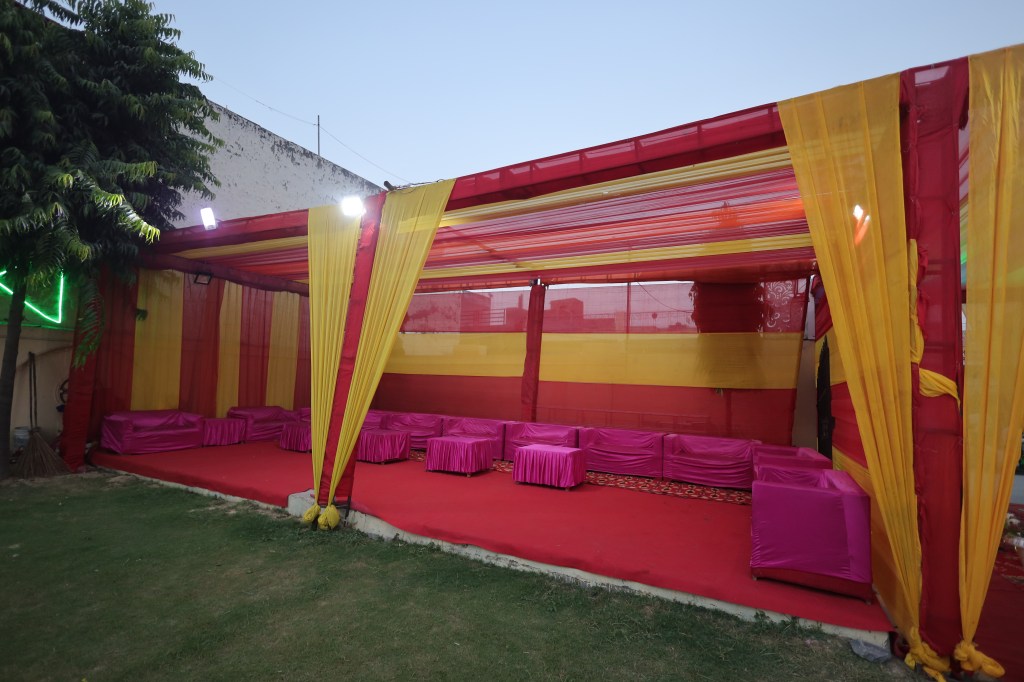
Kavi Nagar is a kothi and lawn area, so the pre-wedding functions were built at home rather than in a banquet. Haldi ran in the morning light with marigold and drape work, low seating and a compact food counter — the kind of function where guests graze continuously rather than sit down to a meal.
The sangeet the same evening needed a different room entirely: a stage for the performances, a dance floor, sound sized to a residential area, and dinner served late without the queue swallowing the dancing.
Days 3 and 4: The Farmhouse on NH-24
A farmhouse gives you space and takes away everything else. No kitchen to borrow, no shop next door, no backup power. Everything arrives on a truck: cooking setup, counters, crockery, tents, furniture, lighting, generators.
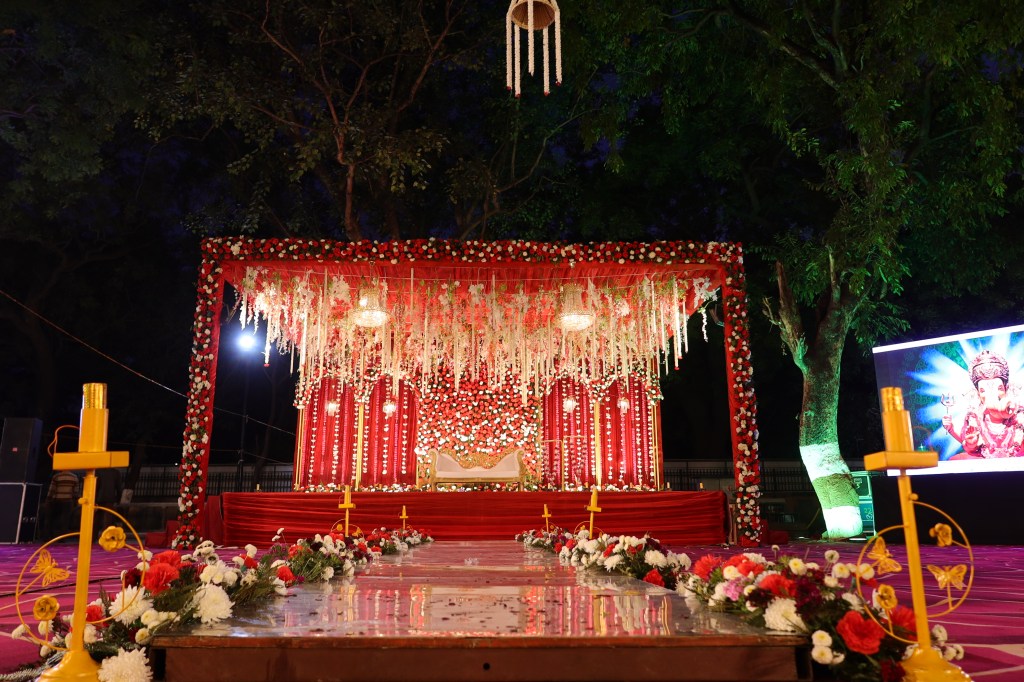
The jaimala stage was the piece the family had strongest feelings about, and rightly — it is where every photograph of the couple gets taken. Red and gold drapes, floral pillars, hanging strings, a lit backdrop and floral edging along the platform, with clear walking room on both sides so the guest queue kept moving.
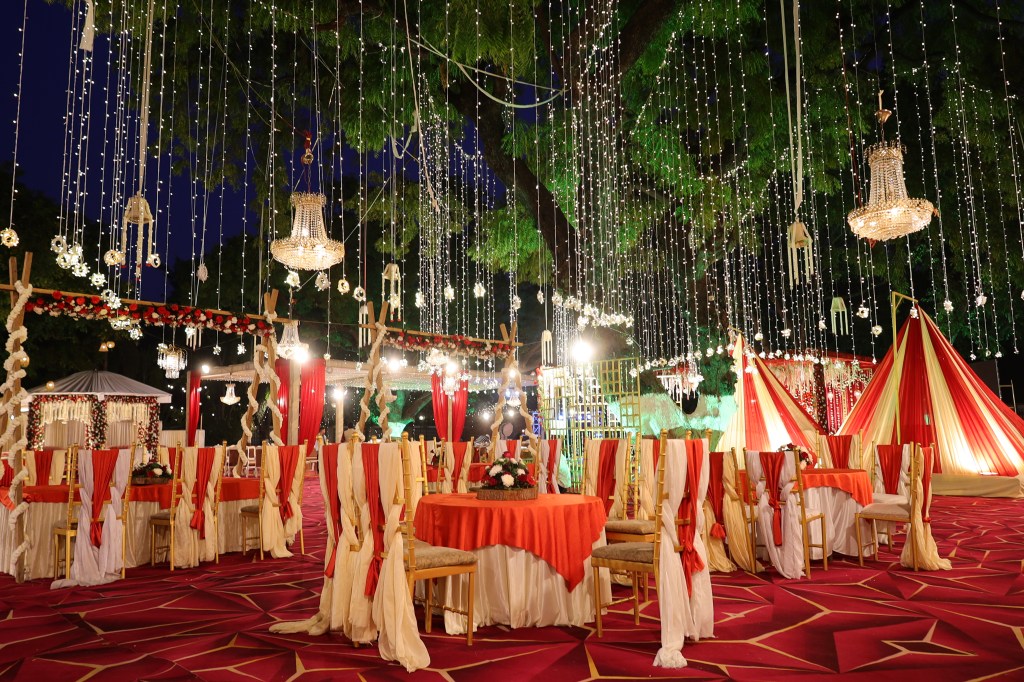
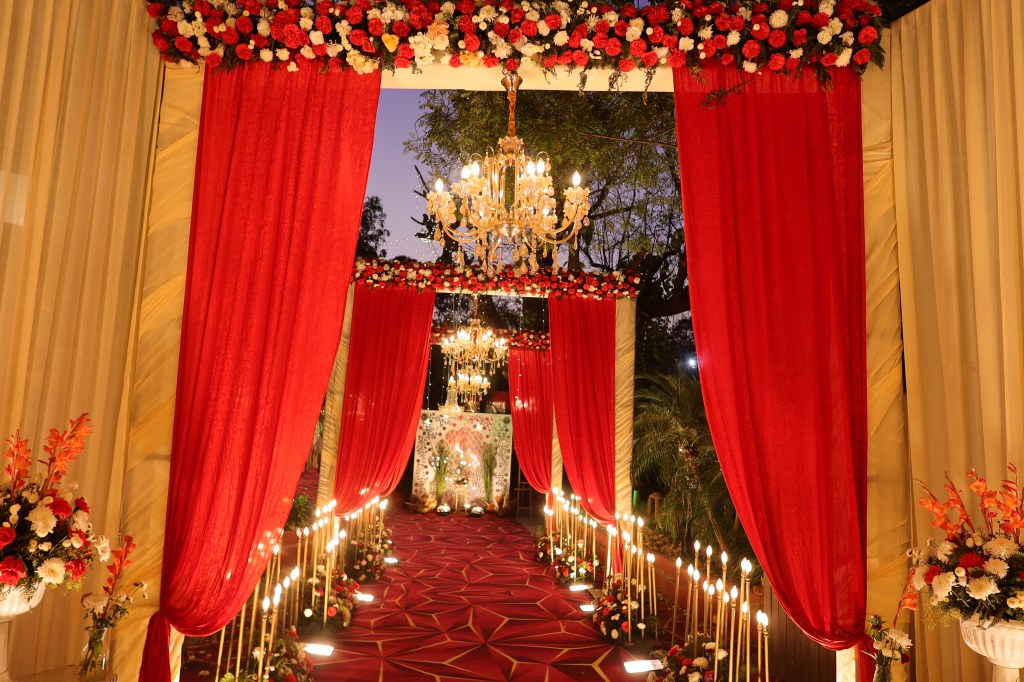
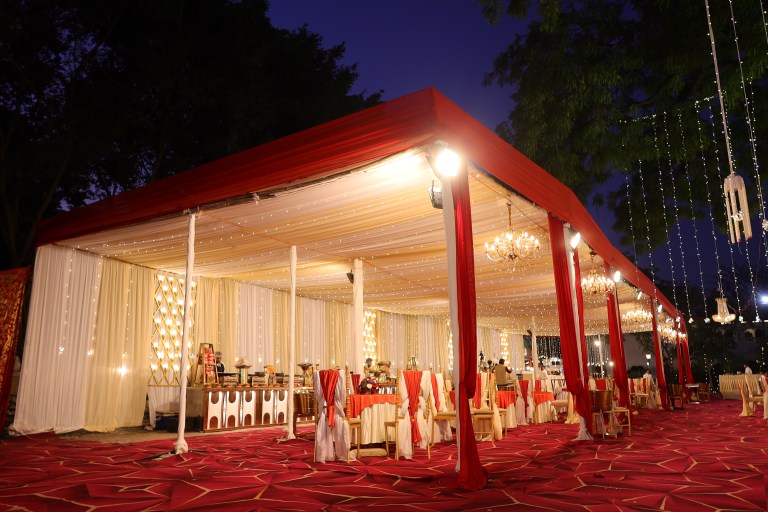
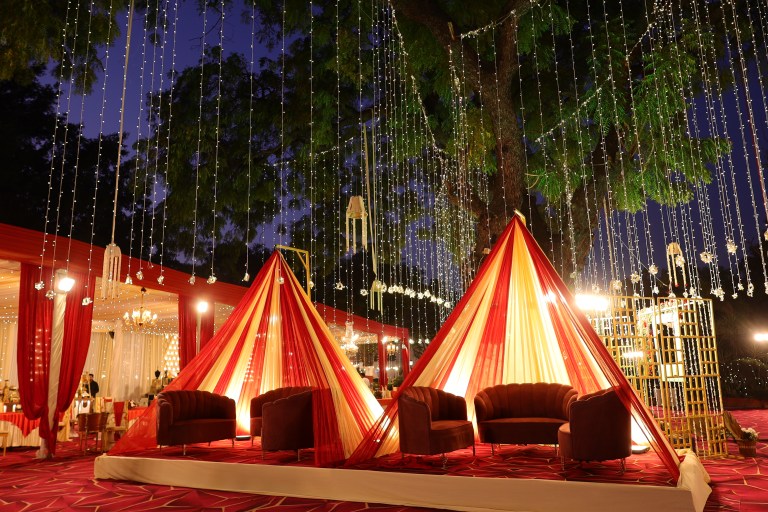
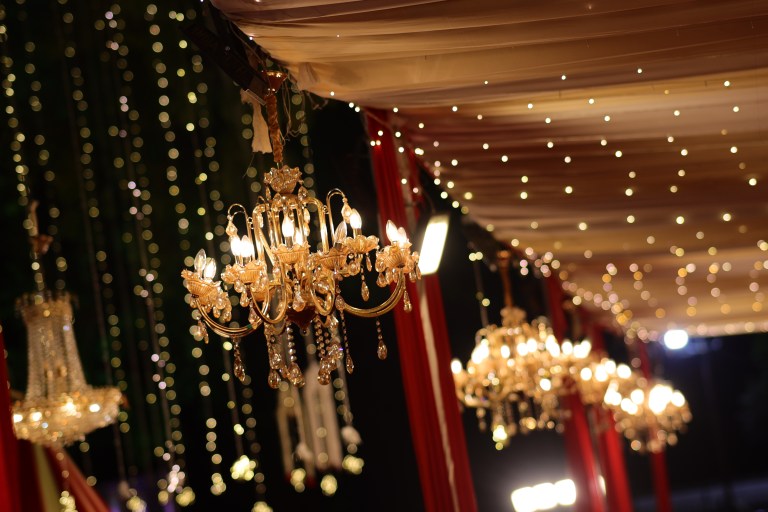
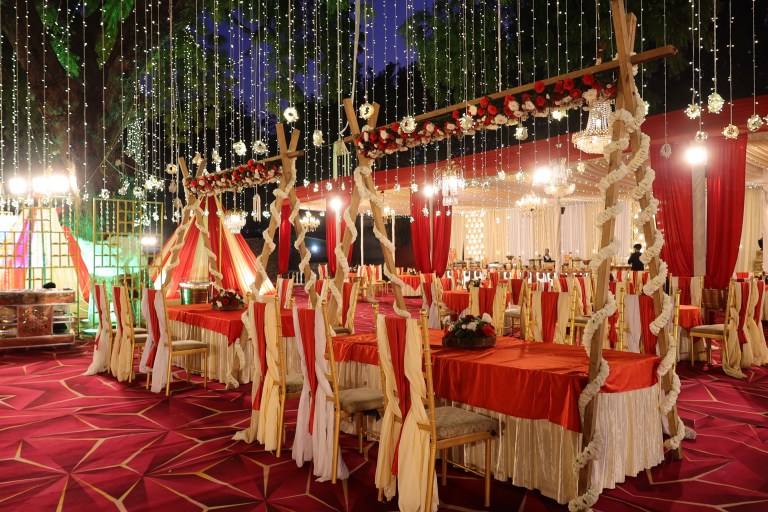
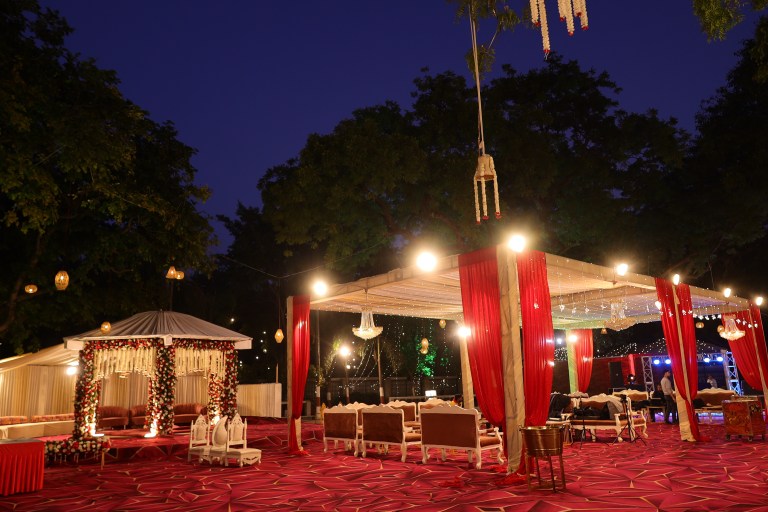
Around these two structures went the rest: tented seating with red and cream drapes, lounge corners for elders, a carpeted walkway, chandeliers and hanging lanterns overhead, and fairy lights run through the trees so the lawn did not go dark beyond the tent line.

The Food: 150+ Dishes, All Vegetarian
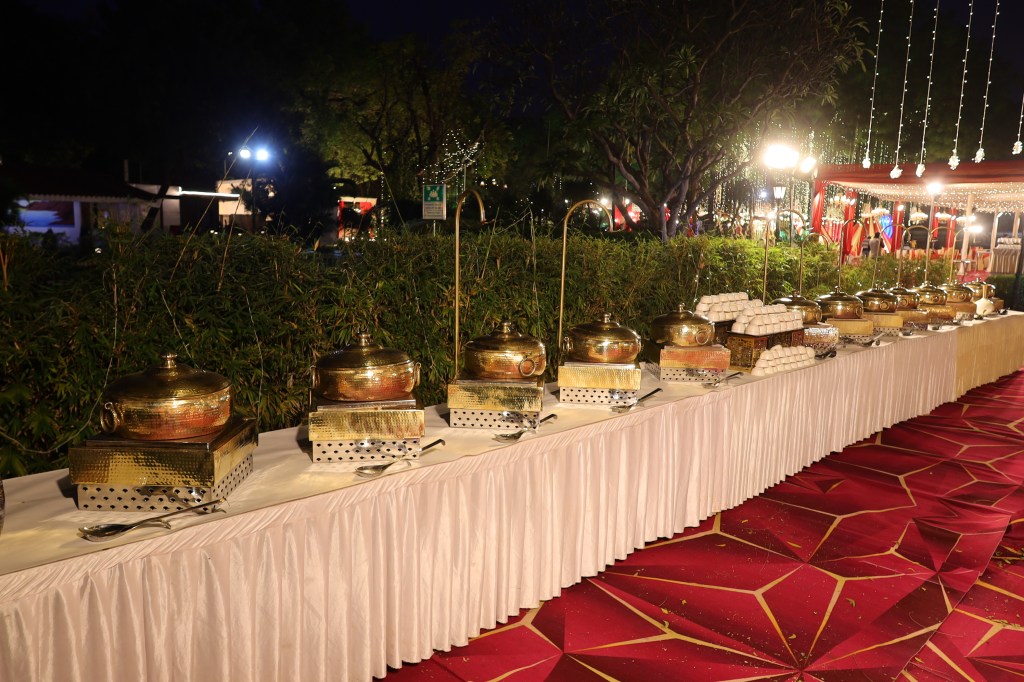
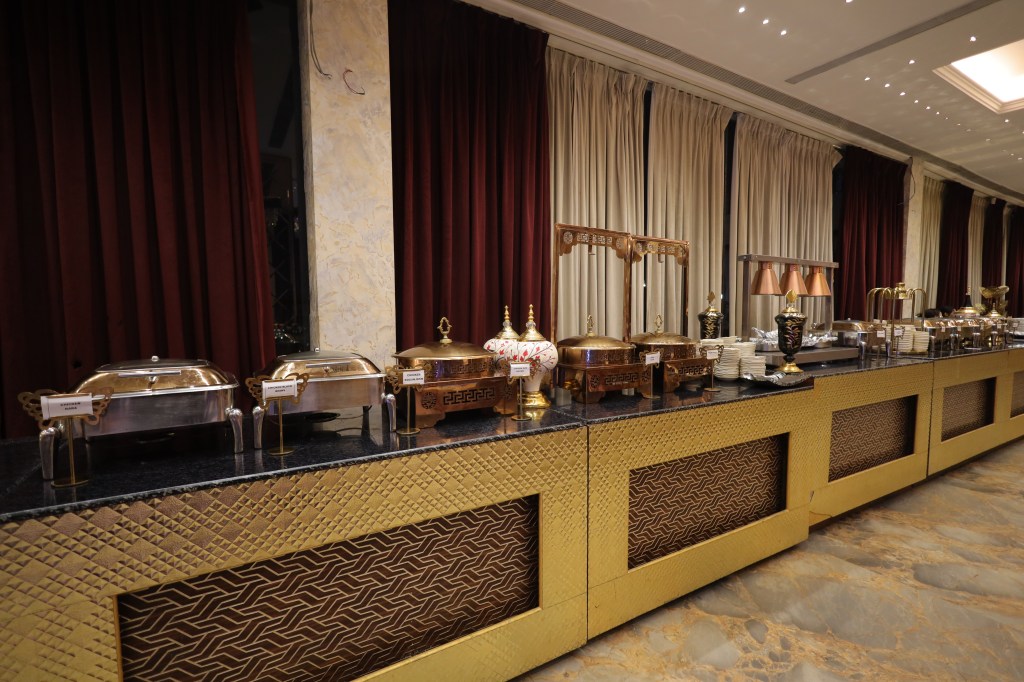
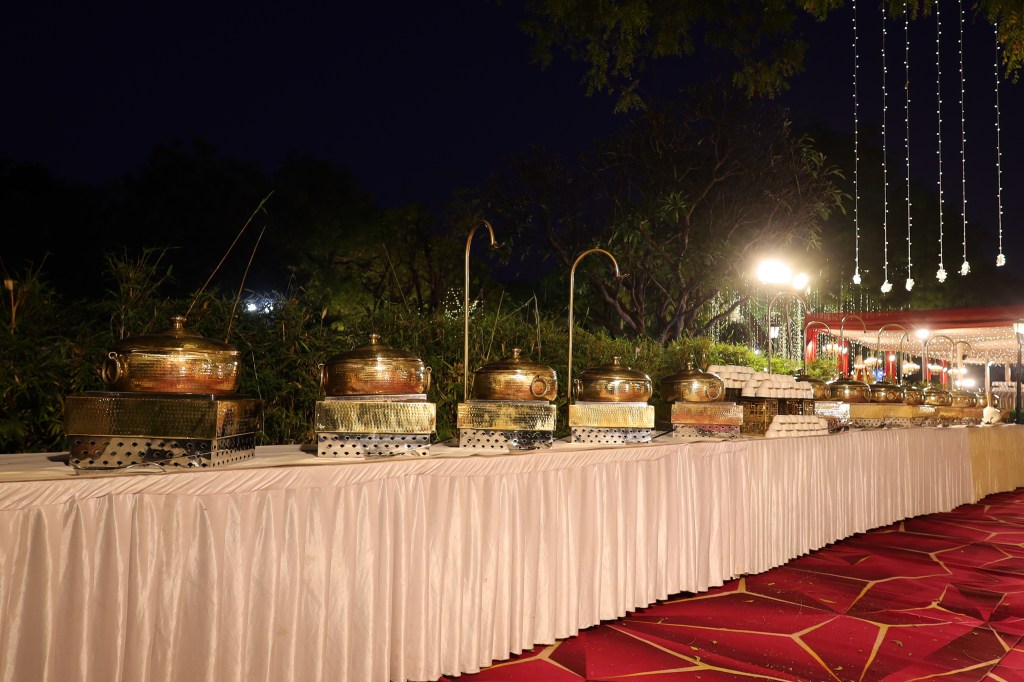
Marwari families judge a wedding on its food, and they know the difference between a long menu and a good one. The spread ran across chaat and golgappa counters, tandoor and tikki, Indo-Chinese, south Indian, a full north Indian main course with paneer, dal, seasonal sabzi, rice and breads, and a dessert section that stayed busy till the end — jalebi with rabri, rasmalai, kheer, halwa and kulfi.
Live counters did most of the work. Food cooked in front of guests moves faster, stays hot, and gives people something to stand around, which is what you want when 400 people arrive at once after the baraat.
The Sangeet Floor
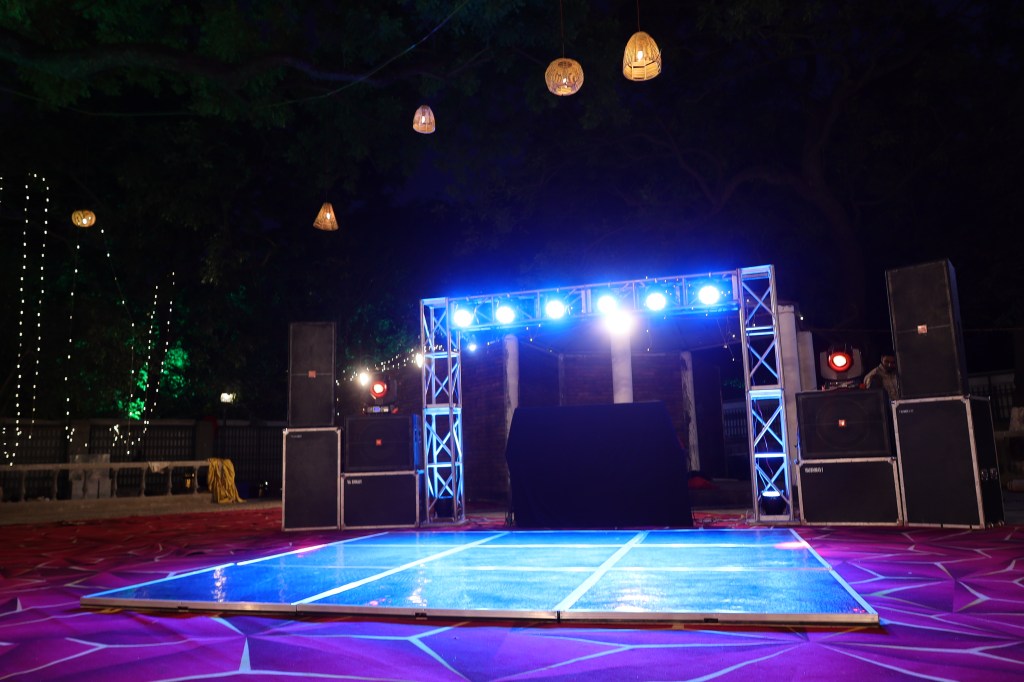
DJ, truss lighting and a lit dance floor, with the sound sized to an open farmhouse rather than a hall. The dhol handed over to the DJ at the baraat, and the music ran till the family called it.
Day 5: Vidaai at First Light
The last function of a five-day wedding happens when everyone is exhausted, which is exactly when the details slip. Ours did not: the Audi A6 was decorated before sunrise, flowers fresh, ready and waiting when the family walked out. The team cleared both venues afterwards and the lawns went back to the owners as they were found.
What the Family Praised
The mandap and the jaimala stage. The counters. The DJ. And the food, which in a Marwari wedding is the verdict that matters. But the compliment we take most seriously came in a different form: across five days, over 4,000 plates and 100-plus staff, nobody in the family had to chase anyone. That is the whole job.
Planning Something Similar?
Start with the dates and the venues, even if nothing else is fixed. See our premium wedding menu, wedding catering cost for 200 to 1,000 guests, mandap and stage décor, and the functions themselves: haldi, mehendi, sangeet and reception.


Leave a comment